Push-pull or single-ended: what the output stage decides
Two amplifiers sit side by side on a shelf. One is a 1960s American push-pull model with four output tubes and 35 watts a channel. The other is a small Japanese-built single-ended amplifier with one big triode per channel and perhaps eight watts. The second costs more. Its owner will tell you it sounds better. The owner of the first will tell you the second can barely drive a bookshelf speaker. Both are partly right, and the reason is a basic choice about how the output stage handles the waveform.
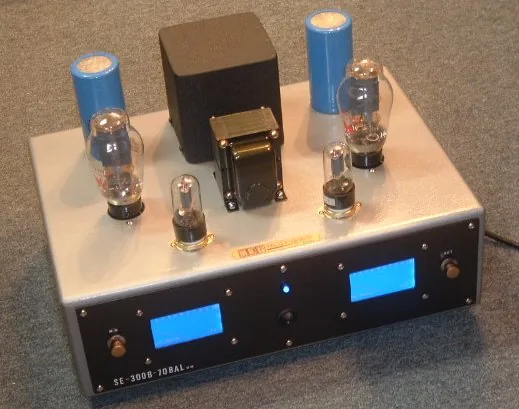
Single-ended: one tube does all the work
In a single-ended output stage, one tube (or several in parallel, all doing the same thing) amplifies the entire waveform. It must be biased so that it never cuts off, which means class A: the tube conducts full current at idle and swings above and below that point as the music moves.
The output tube's plate current flows through the primary of the output transformer all the time, in one direction. That steady DC would saturate an ordinary transformer core, so single-ended transformers are built with an air gap in the core. The gap prevents saturation but lowers the inductance of the primary, which costs bass. The cure is a bigger transformer with more iron and more turns, and that is why a good single-ended amplifier's output transformers can weigh as much as the rest of the chassis.
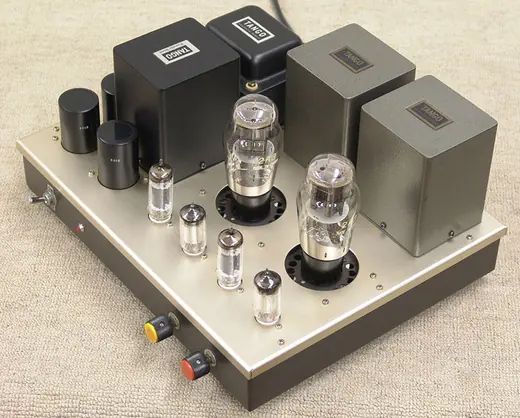
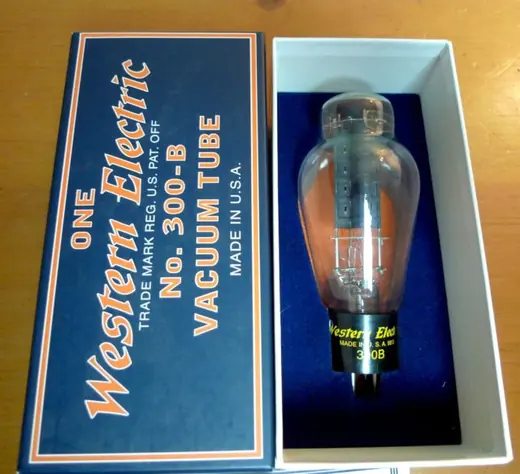
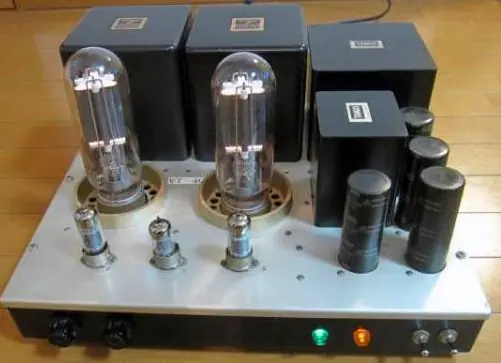
Efficiency is poor. A class A stage with a transformer-coupled output can, in theory, deliver no more than 50% of the power it draws as audio; in practice it does worse. A 300B, a directly heated triode that Western Electric introduced in 1938 to amplify telephone signals, dissipates up to 40 watts on its plate and gives about 8 watts of audio in a single-ended circuit. A 2A3 gives roughly 3 watts. The archive's Sanei Lab 2A3 amplifier and the Western Electric 300B pair sit firmly in this world, and so does the big GE 211 amplifier with Tango iron, where a transmitting triode is pressed into audio service.
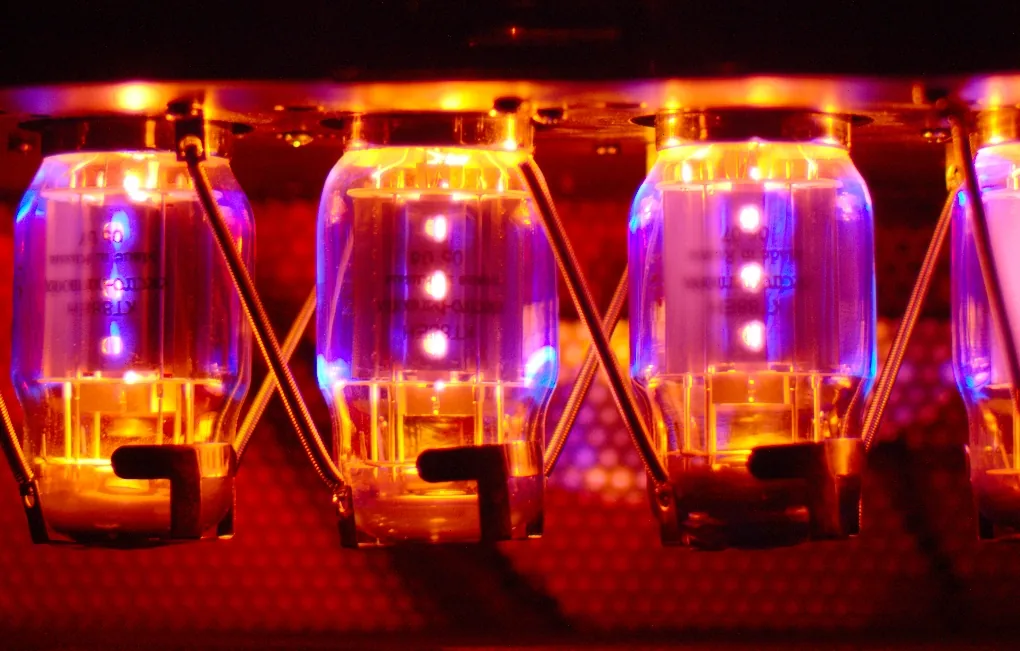
Push-pull: two tubes share the swing
A push-pull stage uses two identical tubes driven in opposite phase by a phase splitter. Their plates connect to the two ends of a centre-tapped output transformer. As one tube's current rises, the other's falls, and the transformer combines the two halves into one waveform at the secondary.
Three useful things happen at once.
First, the DC currents of the two tubes run in opposite directions through the two halves of the primary and cancel in the core. No air gap is needed, and the transformer can be smaller for a given power and bass extension.
Second, distortion produced symmetrically by both tubes cancels. Signal currents add; the even-order harmonics, the second harmonic above all, subtract. A push-pull amplifier measures cleaner than a single-ended one built from the same tubes.
Third, the tubes can be biased into class AB. Each one conducts for more than half the cycle but rests during part of it, so the stage draws little power at idle and delivers much more at full output. A pair of 6L6 tubes in class AB is listed at 55 watts with 450 volts on the plates; an EL34 pair at around 50 watts with fixed bias. The EL84, too, made its name in push-pull: it was the output tube of the British Mullard 5-10 circuit. Compare that with the 8 watts from a single 300B.
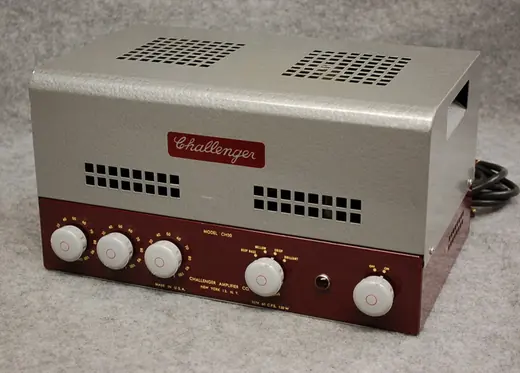
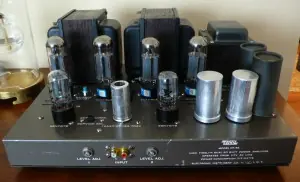
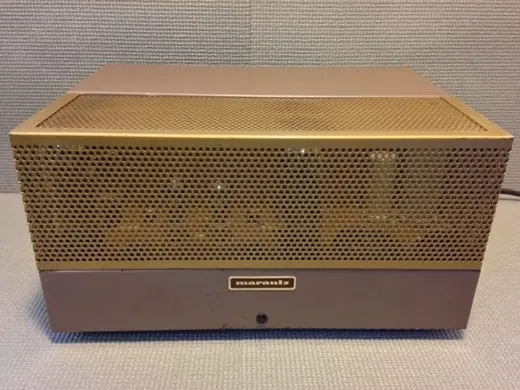
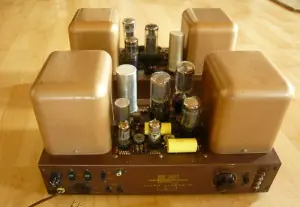
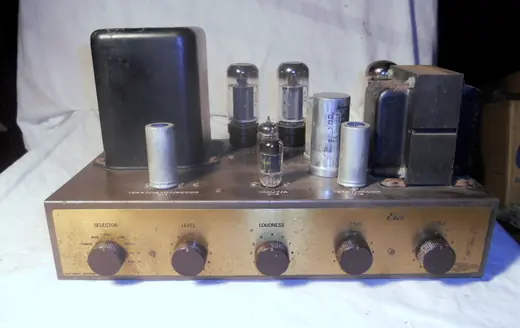
Almost every American home amplifier in this archive is push-pull: the Bogen Challenger CHA-30, the EICO HF-89, the Marantz 8, the Acrosound Ultra-Linear II, the EICO HF-20. It was the sensible engineering answer for the speakers of the time, many of which were not particularly efficient.
So why do people still build single-ended amplifiers?
Because the distortion a single-ended triode produces is mostly second harmonic, and some listeners find that pleasant. Second harmonic is an octave above the fundamental; it thickens a tone without making it harsh. The higher odd harmonics, which push-pull amplifiers with heavy feedback can generate when driven hard, are the ones the ear objects to.
A single-ended triode amplifier also tends to be run with little or no global negative feedback. Its measured distortion is higher, several percent at full power is common, but it rises gradually instead of jumping when the amplifier clips. Fans describe the result as more direct or more spacious. Critics call it euphonic coloration. You can hear both arguments in any listening room.
The practical condition is the loudspeaker. With 3 to 8 watts on tap, you need a speaker that turns a watt into a lot of sound: a horn, a big full-range driver, an old theatre system. The single-ended revival and the interest in Western Electric and Altec theatre gear (see the Altec Lansing 1530T and Westrex-McIntosh 26D pages) grew up together for exactly that reason.
Triode, pentode, beam tetrode: a side note
The single-ended/push-pull choice is separate from the choice of tube type, though people often blur them. A single-ended amplifier can use a pentode such as an EL34 or a beam tetrode such as a KT88, and a push-pull amplifier can use triodes such as the 2A3 or 300B. Pentodes and beam tetrodes can also be wired as triodes by tying the screen grid to the plate; the Williamson amplifier of 1947 did exactly that with KT66s.
Between full pentode and full triode sits the ultra-linear connection, which became the standard compromise for American push-pull amplifiers in the 1950s.
Which one should you buy?
Start with your speakers, not the amplifier. If they are modern, moderately sensitive box speakers, a single-ended amplifier will run out of headroom at sensible listening levels, and you will hear it clip on drum hits. A push-pull amplifier of 20 to 40 watts a channel is the safer partner. The vintage market is full of them, and parts are easy to find.
If you have high-efficiency speakers and you listen mostly to small-scale music at moderate volume, a single-ended triode is worth hearing before you decide. Bring your own records. Listen for what happens at the loud passages.
And if you are buying for collecting rather than listening, the archive's history speaks for itself: the American push-pull classics are the ones with documented production runs, service literature and a parts trade that still supports them. A rare Japanese single-ended amplifier may be wonderful, but you may be the only person in the country who knows how to fix it.
A quick comparison
| Single-ended | Push-pull | |
|---|---|---|
| Output tubes per channel | One (or several in parallel) | Two, or two groups, driven in opposite phase |
| Class | A | A, AB or B; AB1 most common in hi-fi |
| Output transformer | Gapped core, carries DC; large for good bass | DC cancels; no gap needed |
| Typical distortion | Mostly second harmonic, several percent at full power | Even harmonics cancel; lower measured distortion |
| Example power | 2A3 about 3 W; 300B about 8 W | 6L6 pair 55 W in class AB; EL84 pair 17 W |
| Phase splitter needed | No | Yes |
| Speaker match | High-efficiency horns and full-range drivers | Most conventional speakers |
Short answers
How much power does a single-ended 300B amplifier make?
About 8 watts per channel in a typical single-ended circuit, according to the published figures for the tube. A push-pull pair of 300Bs gives roughly 20 watts.
Can a single-ended amplifier drive ordinary bookshelf speakers?
It will play, but with 3 to 8 watts it runs out of headroom quickly on speakers of average sensitivity, and you will hear it clip on loud passages. High-efficiency horns and full-range drivers are the natural partners.
Why is second-harmonic distortion described as pleasant?
The second harmonic is an octave above the note being played, so it thickens the tone without adding harsh, unrelated frequencies. Push-pull amplifiers cancel most of it; single-ended triode amplifiers keep it.
Checked against: Wikipedia: Single-ended triode · Wikipedia: Push–pull output · Wikipedia: 300B · Wikipedia: 6L6 · Wikipedia: EL34 · Wikipedia: EL84