How a tube tester works, and what its needle is not telling you
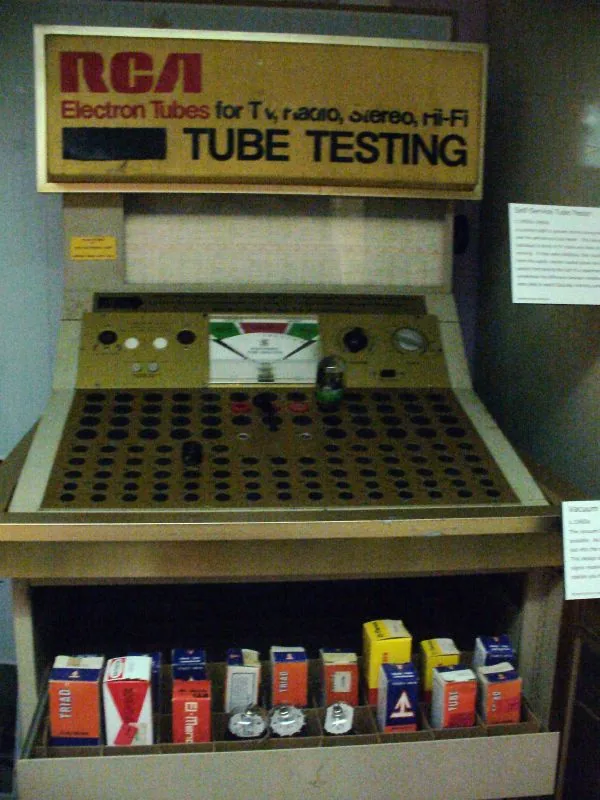
From the late 1920s until the early 1970s, a lot of American drugstores and grocery stores had a tube tester near the door. You pulled the tubes from your radio or television, brought them in a paper bag, set the dials from a roll chart, and pressed a button. A needle swung into a green zone marked GOOD or a red one marked REPLACE, and the store sold you the replacement from a cabinet underneath. When transistors took over, the grocery-store tester vanished, and the good ones went to repair shops, hams and, eventually, collectors.
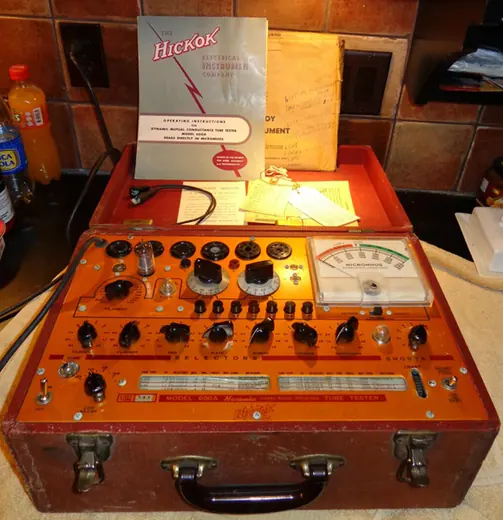
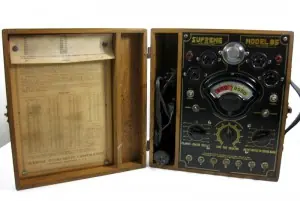
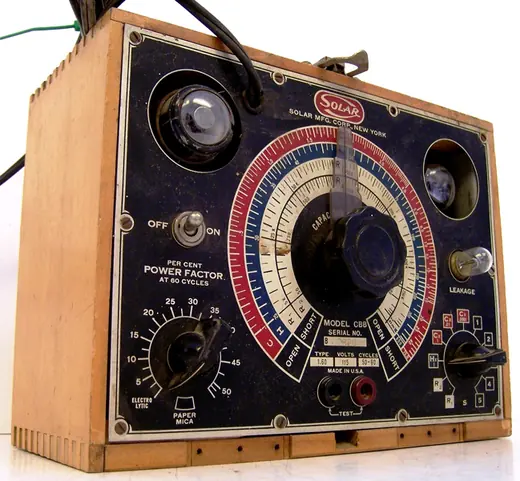
Today a tester reading is part of almost every tube sale. Knowing what the reading actually measured is the difference between buying a good tube and buying a story. The archive has two testers worth looking at alongside this guide: the Hickok 600A and the Supreme Instruments Model 85. There is also a Solar capacitor analyzer, its natural bench companion.
What can go wrong inside a tube
A tester exists to catch four kinds of failure.
The heater or filament can burn open, like a light bulb. The tube is simply dead.
Elements can short. The grid touches the cathode, or the heater insulation breaks down and leaks to the cathode. A shorted tube can take other parts in the circuit with it.
The cathode can wear out. Its coating loses the ability to emit electrons, so the tube passes less current than it should. This is the slow, normal ageing of a tube.
Gas can get in. A leak or outgassing inside the envelope lets ions form, which upsets the grid and can cause runaway current in an output stage.
The simple testers
The simplest device checks only filament continuity: a neon lamp and a resistor in series with the heater. It confirms the heater is intact and nothing else. A multimeter on the resistance range does the same job.
The next step up treats the tube as a crude rectifier, with every element except the filament tied together as one big anode. That gives a rough idea of emission for directly heated tubes and catches heater-to-cathode leakage in indirectly heated ones.
Emission testers
An emission tester connects the tube as a diode: grids and plate tied together, a voltage applied, and a meter reading how much current the cathode can supply. Older instruments of this kind were labelled "plate conductance" or "cathode conductance". Emission testers usually included a short test using a neon lamp, flicking through combinations of elements to see whether any pair conducted when it should not.
Emission testing has one real strength: it gives the earliest warning of a wearing cathode. Wikipedia's article on tube testers gives an example in which emission has fallen to 70% while transconductance is still at 90% and gain at 100%. The tube is ageing, but it still works perfectly in the circuit.
That example also shows the weakness. An emission tester does not measure how the tube amplifies. It tests at low voltages, under static conditions, sometimes with the grid driven positive in a way it never would be in an amplifier. It can pass a tube that is noisy or microphonic, and it can reject a tube with low emission that would still serve for years in a gentle circuit.
The Jackson Electrical Company of Dayton, Ohio, developed a variation called dynamic conductance, which applies proportional AC voltages to grid and plate rather than DC. It is still, at heart, an emission-style test.
Mutual conductance testers
A mutual conductance (or transconductance) tester asks a better question: if I change the grid voltage by a small amount, how much does the plate current change? That ratio is the tube's transconductance, measured in micromhos, and it is the property an amplifier circuit actually uses.
The tester applies proper DC voltages to the plate and screen, sets a bias on the control grid, then adds a small AC signal to the grid and measures the resulting AC change in plate current. Hickok's "dynamic mutual conductance" instruments, like the ones in this archive, are the best-known American examples, and service shops trusted them for decades.
A good transconductance reading means the tube amplifies the way it should at the tester's operating point. It does not guarantee the tube behaves identically at the higher voltages of a real amplifier. That is why reputable sellers of output tubes for hi-fi often add a note about the test conditions, or use a tester that can work at realistic plate voltages.
Parametric testers and curve tracers
The laboratory end of the field applies full datasheet voltages and measures what the tube does, sometimes plotting its full family of characteristic curves. The AVO valve testers in Britain and the Funke W20 in Germany worked along these lines; the Tektronix 570 plotted curves on an oscilloscope screen. Modern computer-controlled testers such as the Amplitrex AT1000 do the same work automatically and are what serious matched-pair sellers use now.
Reading a seller's numbers
When a listing says a tube "tests strong", ask three things.
What kind of tester? An emission reading and a transconductance reading are different measurements. A seller who does not know which one they took is guessing.
What was the reference? Most testers compare the reading with a "good" figure for that tube type, printed on a roll chart or in a manual. A reading of 3,000 micromhos means nothing unless you know the expected value for the type and the tester.
Were shorts and gas tested? A tube that shows high transconductance and a flicker of short can still be scrap.
For matched pairs of output tubes, also ask how closely the plate currents match at a stated bias. Push-pull amplifiers run best when both tubes in a pair draw similar current. A difference of a few percent is normal; large differences cause hum in the output transformer and uneven wear.
Should you buy a tester?
If you own one or two amplifiers, probably not. A reliable test is cheaper from a repair shop, and swapping a suspect tube for a known good one tells you most of what you need. If you collect, buy NOS tubes or restore amplifiers regularly, a well-calibrated mutual conductance tester pays for itself, but budget for its own service. Old testers have rectifiers, resistors and meters that drift, and a tester that reads wrong is worse than none. Look for one with its original roll chart or an updated set of settings, and have the calibration checked before you trust it with expensive tubes.
Once you have one, keep a log. Note the date, the tester, the roll-chart settings and the reading for every tube you check, and retest the same tube with the same settings a year later. One reading tells you little; a series shows a tube slowly losing emission long before it fails. The habit is the one taught for collecting data in a research project: the same method every time, written down as you go, never from memory.
The same goes for the capacitor analyzer beside it. On a vintage amplifier, capacitors fail far more often than tubes. A tester that tells you your tubes are fine is useful. A meter that tells you the coupling capacitor is leaking is often more useful still.
Short answers
What is the difference between an emission tester and a mutual conductance tester?
An emission tester measures how much current the cathode can supply with the tube connected as a diode. A mutual conductance tester measures how much the plate current changes for a small change in grid voltage, which is the property an amplifier actually uses.
Can a tube that tests weak still work well?
Yes. An emission reading can fall well before the tube's gain does. Wikipedia's example has emission at 70% while transconductance is still 90% and gain 100%. Whether the tube is usable depends on the circuit.
Do old tube testers need calibration?
Yes. Their meters, resistors and rectifiers drift with age, so a tester that has not been checked can misread every tube. Have it serviced before relying on it for expensive tubes or matched pairs.
Checked against: Wikipedia: Tube tester