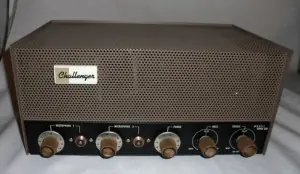
Bogen Challenger CHA-30 Tube Amplifier
Archived listing from the original vintage-amplifier.com. Prices, seller details and purchase links have been removed; this page is a reference record, and nothing here is for sale. About this archive.
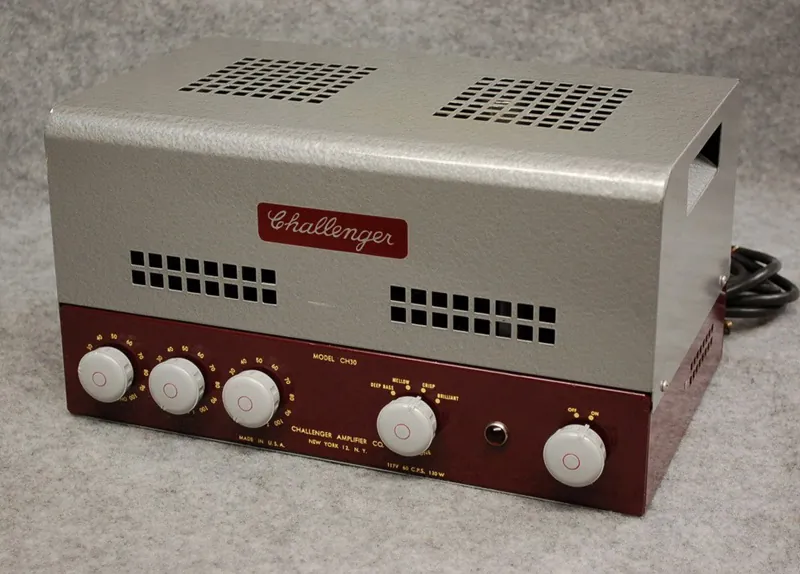
This is a great looking amp. It has the large style 6L6G tubes, and looks to have all original parts. It sounds good on all inputs. This would be great for using as a guitar or bass amp, even a harp amp. It comes with the top cover, and bottom cover. The cord was cracked so I replaced it with a 3 prong grounded cord.
About this model
The seller of this Challenger singled out its "large style" 6L6G output tubes: the original shouldered-glass version of the 6L6, the tube RCA introduced in 1936 as the first successful beam power tube. Seeing the G-type bottles still in place usually means an early amplifier that has not been re-tubed with later GC versions.
The listing reports original parts, working inputs, both covers present and a replaced three-prong grounded cord. It also suggests guitar, bass or harmonica use, which is how many Challengers survive today: PA amplifiers built heavily enough to take abuse on stage.
| Maker | David Bogen Company, USA |
|---|---|
| Series | Challenger (public address) |
| Output tubes | 6L6G (as described in the listing) |
| Covers | Top and bottom covers present (listing) |
| Mains lead | Replaced with a three-prong grounded cord (listing) |
Questions collectors ask
What is the difference between a 6L6G and a 6L6GC?
Both are 6L6 beam tetrodes. The G suffix marks the large shouldered glass envelope of the early versions; the GC is a later, more robust version rated at 30 watts of plate dissipation.
Can a Bogen Challenger be used as a guitar amplifier?
Many are, often with small modifications. The original seller suggested guitar, bass or harmonica. Have the capacitors checked first, and use a suitable speaker cabinet.
Sources: Wikipedia: 6L6; Wikipedia: Terry Kath.