6L6, EL34, KT88, 12AX7: a field guide to amplifier tubes
Read enough old amplifier listings and the tube numbers start to look like a private language. 6L6. EL34. 6CA7. KT88. 12AX7. ECC83. 5AR4. GZ34. Half of them are the same tube under a different name, and the other half decide whether an amplifier makes 10 watts or 100. This is a field guide to the ones that appear most often in this archive, with the numbers that matter when you are buying an amplifier or a set of replacements.
How to read the names
American tubes use the RETMA system. The first number is roughly the heater voltage (6 for 6.3 volts, 12 for 12.6), the letters are a serial code, and the last digit counts the elements. Suffixes describe the envelope: G for the large shouldered glass bulb, GT for the smaller straight-sided "tubular" glass, and letters such as A, B or C for later improved versions. So a 6L6GC is a 6.3-volt beam tetrode in a glass envelope, one of the later, higher-rated revisions.
European tubes use the Mullard–Philips system. The first letter is the heater rating (E for 6.3 volts), the following letters describe the function (L for an output pentode, C for a triode, CC for a double triode, Z for a full-wave rectifier), and the number identifies the type and base. An EL34 is a 6.3-volt power pentode; an ECC83 is a 6.3-volt double triode.
British GEC/Marconi-Osram tubes added the KT ("kinkless tetrode") family: KT66, KT77, KT88.
Many tubes carry two names. The EL34 is the 6CA7 in American notation. The EL84 is the 6BQ5. The ECC83 is the 12AX7. A listing that says "6CA7 output tubes" and another that says "EL34" may be describing identical amplifiers.
Output tubes
6L6 (and 5881, 7027)
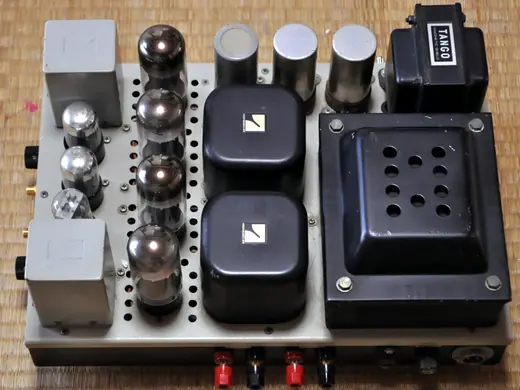
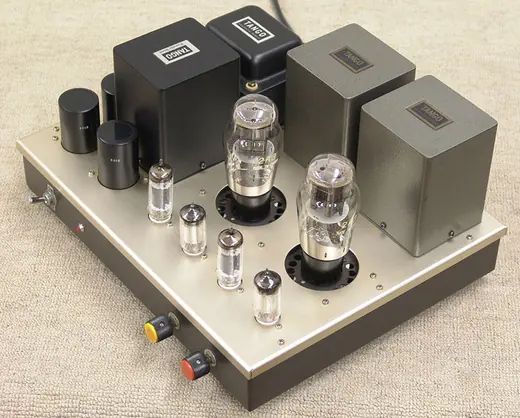
RCA introduced the 6L6 in April 1936, and it was the first successful beam power tube on the market. It went through a long string of versions: 6L6G, 6L6GA, 6L6GB, the rugged military 5932/6L6WGA, and the 6L6GC with a 30-watt maximum plate dissipation. The 5881 is listed as an improved substitute. The original metal 6L6 of 1936 was rated at 24 watts combined plate and screen dissipation, well below the later GC. A pair in class AB with 450 volts on the plates is rated at 55 watts. You will find 6L6s in American hi-fi, in public-address amplifiers from makers such as Bogen, and above all in guitar amplifiers. The archive's 6L6 amplifier with Luxman and Tango parts shows the tube in a Japanese home-built setting.
6V6
The 6L6's smaller cousin. Ken-Rad brought out the glass 6V6G in late 1936 and Sylvania announced the metal 6V6 in January 1937. A single 6V6 gives about 5 watts; a push-pull pair about 14. It was built for car radios and tabletop sets and ended up powering Fender's Champ, Princeton and Deluxe guitar amplifiers, along with countless console stereos. The Magnavox 8802 in this archive is a 6V6 stereo amplifier.
EL34 / 6CA7
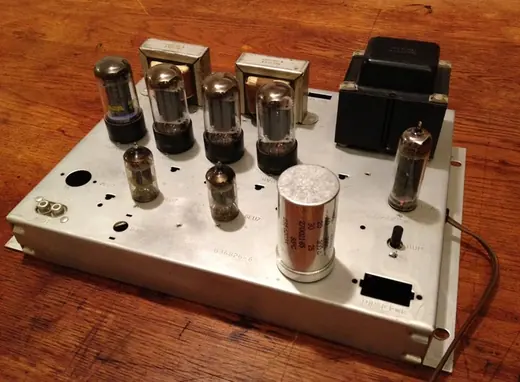
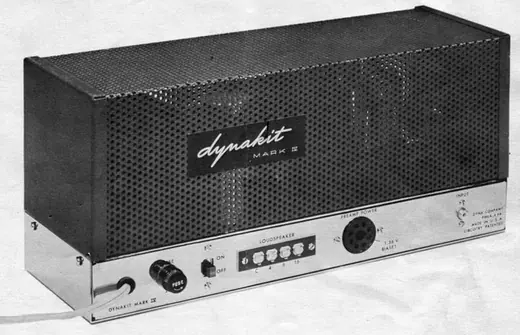
Mullard, then owned by Philips, introduced the EL34 in 1955. It is a power pentode on an octal base, with a 6.3-volt heater drawing 1.5 amps and a 25-watt maximum plate dissipation. A pair produces about 50 watts with fixed bias at 375 to 450 volts; four of them give around 100 watts, which is the typical guitar-amplifier arrangement. The EL34 powered the Dynaco Stereo 70 and the Leak TL25 mono amplifier and Stereo 60, and it is the defining tube of many 1960s British and American hi-fi designs.
EL84 / 6BQ5
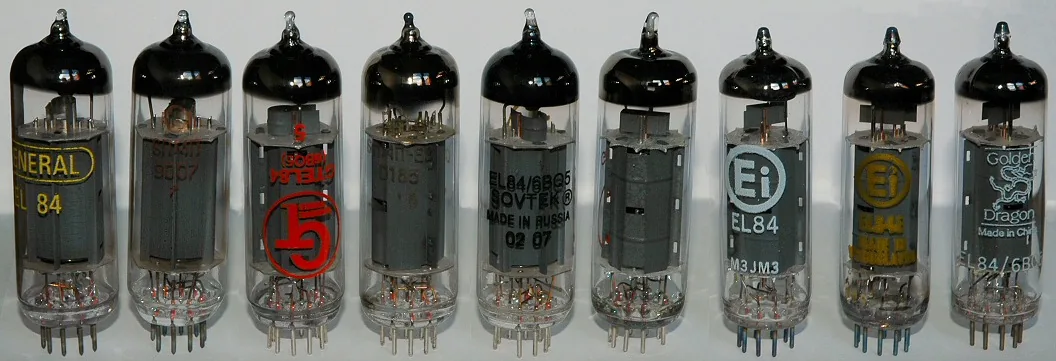
Philips developed the EL84 in 1953. It is a small power pentode on a nine-pin noval base, with a 12-watt maximum plate dissipation. Two of them in class AB push-pull give about 17 watts. The EL84 turned up in radios and modest hi-fi amplifiers across Europe and became famous in Vox guitar amplifiers in the 1960s. When an amplifier listing mentions "6BQ5", it is the same tube.
KT88
GEC introduced the KT88 in 1956 as a larger version of the KT66. Made in Britain by the Marconi-Osram Valve company, it is a beam tetrode rated at 42 watts of plate dissipation with plate voltages up to 800 volts. A push-pull pair in class AB1 can give 100 watts at 2.5% distortion, or around 50 watts at the low distortion expected in hi-fi. It has higher ratings than the American 6550, which is often used as a substitute. It sits at the top of the classic power-tube ladder.
The directly heated triodes: 2A3, 300B, 211
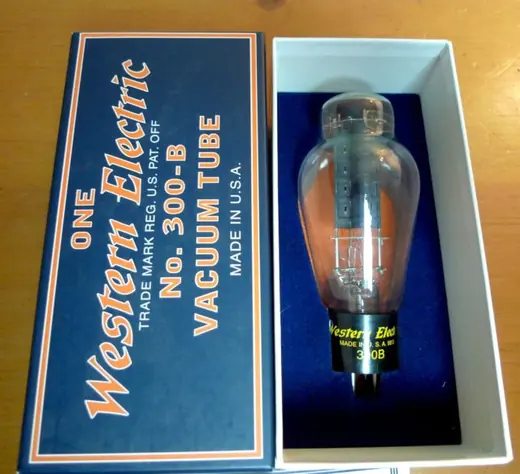
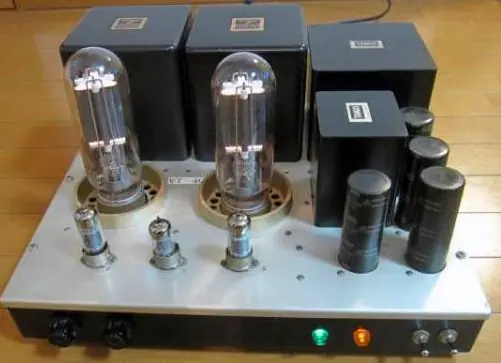
These are older and simpler. In a directly heated triode the filament itself emits the electrons; there is no separate cathode. The 300B was introduced by Western Electric in 1938 to amplify telephone signals; it dissipates up to 40 watts on the plate and gives about 8 watts single-ended, or about 20 in a push-pull pair. Western Electric resumed production of the original 300B in Rossville, Georgia, in 2018. The archive has a pair of Western Electric 300B reissues. The 2A3 gives around 3 watts single-ended; see the Sanei Lab 2A3 amplifier. The 211 is a transmitting triode that needs high plate voltage and heavy grid drive; the GE 211 amplifier shows what that looks like in practice.
Small-signal tubes
12AX7 / ECC83
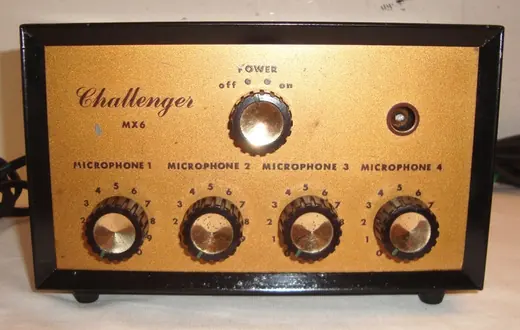
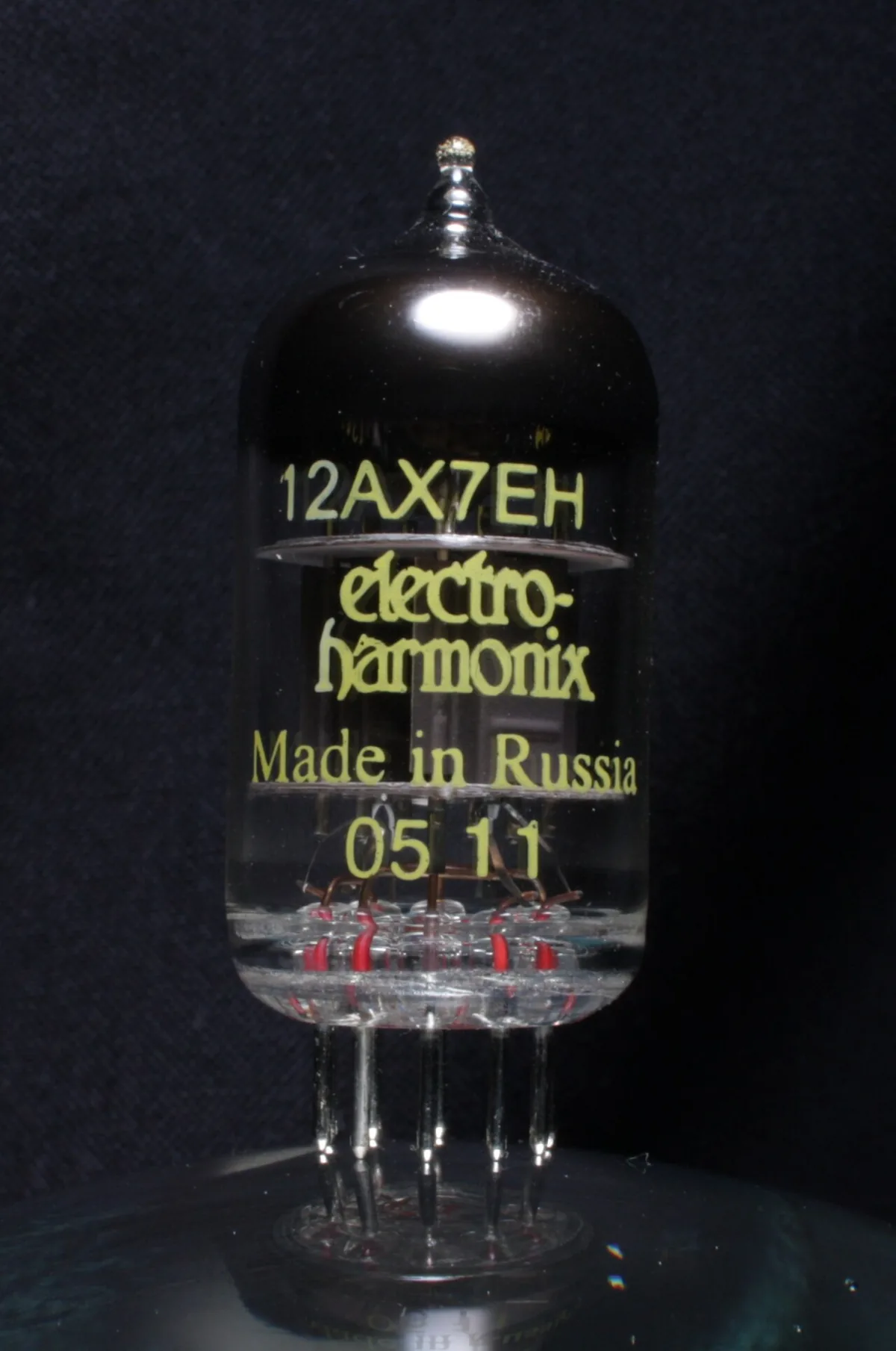
RCA engineers in Camden, New Jersey, developed the 12AX7 around 1946 and it went on public sale on 15 September 1947. It is a miniature dual triode with an amplification factor of about 100. Its heater is centre-tapped, so it runs on 12.6 volts at 150 mA or 6.3 volts at 300 mA. It is the standard preamp and input tube: phono stages, tone controls, the first stage of a power amplifier, and nearly every guitar amplifier. The Bogen MX6 makes a point of its pair of 12AX7s.
12AT7 and 12AU7
Same family, same pinout, lower gain: about 60 for the 12AT7 and 17 to 20 for the 12AU7. Designers used them where a 12AX7 would give too much gain or not enough drive current, typically in phase splitters and driver stages. Swapping a 12AU7 into a 12AX7 socket will not damage anything but will change how the circuit behaves.
Rectifiers
A rectifier tube turns the AC from the power transformer into DC for the plates. Common types include the 5U4, 5Y3, 5AR4 (European name GZ34) and the 5V4G. They differ in how much current they can supply and how much voltage they drop. The 5AR4/GZ34 has an indirectly heated cathode and warms up slowly, which brings the high voltage up gently. Substituting one type for another changes the supply voltage, sometimes by tens of volts, so check the manual before you swap.
Indicators and oddities
Not every tube amplifies. The Telefunken EMM 801 in this archive is a tuning indicator, one of the "magic eye" family that glow green and show signal strength on tuners and tape recorders. The Philips Miniwatt page and the 1950 RCA receiving tube manual are good places to see how makers presented their ranges at the time.
Quick reference
| Tube | Also sold as | Type | Introduced | Max plate dissipation | Typical output |
|---|---|---|---|---|---|
| 6L6GC | 5881 (substitute) | Beam tetrode, octal | 1936 (original 6L6) | 30 W | 55 W per pair, class AB |
| 6V6 | 6V6GT | Beam tetrode, octal | 1936–37 | see data sheet | ~5 W single, ~14 W per pair |
| EL34 | 6CA7 | Power pentode, octal | 1955 | 25 W | ~50 W per pair, fixed bias |
| EL84 | 6BQ5 | Power pentode, noval | 1953 | 12 W | 17 W per pair, class AB |
| KT88 | 6550 (substitute) | Beam tetrode, octal | 1956 | 42 W | ~50 W hi-fi, 100 W max per pair |
| 300B | Directly heated triode | 1938 | 40 W | ~8 W single-ended | |
| 2A3 | Directly heated triode | 1930s | see data sheet | ~3 W single-ended | |
| 12AX7 | ECC83 | Dual triode, noval | 1947 | small-signal | gain (μ) about 100 |
One last piece of advice for anyone shopping for replacements: "NOS" means new old stock, a tube made decades ago and never used. It does not guarantee a good tube. Ask for test readings and find out what kind of tester produced them.
Short answers
Is a 6CA7 the same as an EL34?
6CA7 is the American designation for the EL34 power pentode, which Mullard introduced in 1955. Amplifier listings use both names for the same type.
Can I put a 12AT7 or 12AU7 in place of a 12AX7?
They share the same pinout, so nothing is damaged, but the gain is much lower: about 60 for the 12AT7 and 17 to 20 for the 12AU7, against about 100 for the 12AX7. The circuit will behave differently.
Which output tube gives the most power?
Of the common audio types, the KT88: a push-pull pair can produce about 100 watts at 2.5% distortion, or about 50 watts at hi-fi distortion levels. It is rated for 42 watts of plate dissipation.
What does NOS mean on a tube listing?
New old stock: a tube made years ago and never used. It does not guarantee the tube is good. Ask for test readings and the type of tester used.
Checked against: Wikipedia: 6L6 · Wikipedia: 6V6 · Wikipedia: EL34 · Wikipedia: EL84 · Wikipedia: KT88 · Wikipedia: 300B · Wikipedia: 12AX7 · Wikipedia: Single-ended triode