Ultra-linear explained: Blumlein's tap and the Philadelphia badge
Look at the badge on half the American power amplifiers made between 1952 and 1965 and you will find the words "Ultra-Linear" somewhere: on the faceplate, on the transformer can, in the catalogue copy. It sounds like advertising, and by 1960 it mostly was. But the term began as a precise piece of engineering, published by two men from Philadelphia who went on to found Acrosound and, later, Dynaco.
The problem it solved
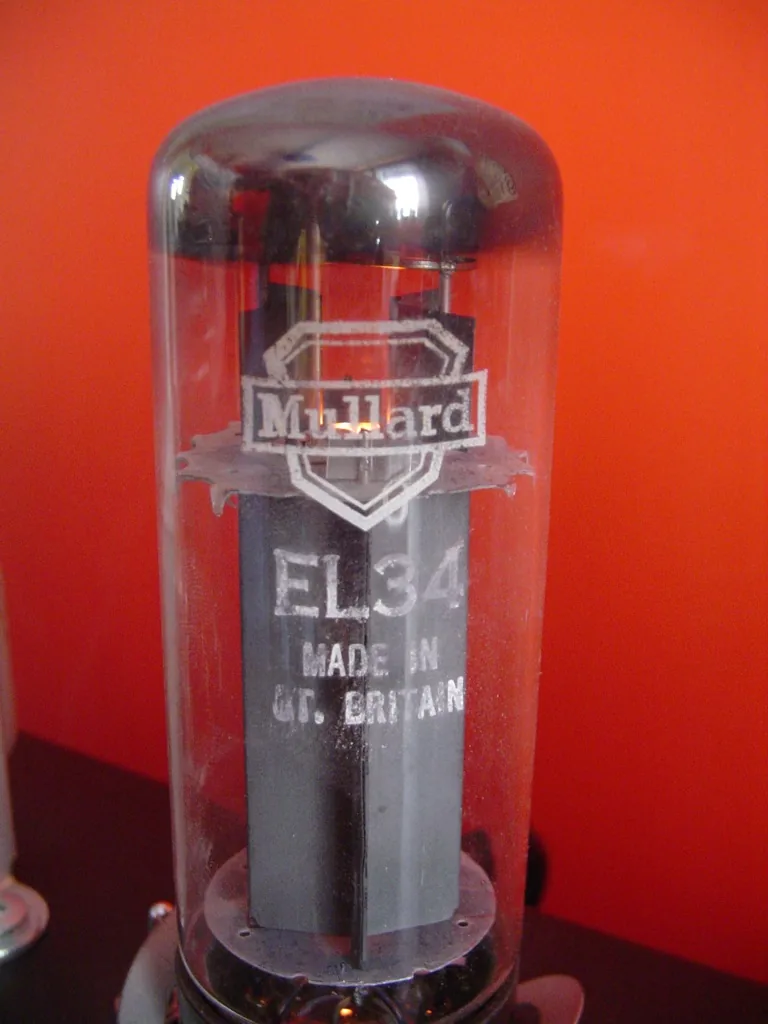
An audio power tube of the early 1950s was usually a pentode or a beam tetrode: an EL34, a 6L6, a KT66. These tubes have a screen grid between the control grid and the plate, held at a steady positive voltage. The screen makes them efficient and gives high power from modest drive. It also makes them less linear than a triode, with more of the odd-order distortion that sounds harsh, and a high output impedance that leaves the loudspeaker poorly damped.
Wire the screen grid straight to the plate and the tube behaves like a triode. Distortion falls and the output impedance drops, but so does the power: you might lose half the output of the same pair. The Williamson amplifier of 1947 took this route with KT66 tubes in triode connection, and its 15 watts was considered plenty at the time. As speakers grew larger and listeners wanted more, the compromise began to hurt.
Blumlein's idea, Hafler and Keroes' name
The fix had been sitting in a British patent since 1937. Alan Blumlein, the EMI engineer better known for stereo recording, patented what he called "distributed loading" (UK Patent No. 496,883) and applied for a US patent the following year. Instead of tying the screen grid to a fixed voltage or to the plate, connect it to a tap partway along the output transformer's primary winding. The screen then receives a fraction of the plate's signal swing.
Connect the screen at 0% of the winding and you have a pentode. At 100%, a triode. Somewhere in between, the tube behaves like a blend of both.
In November 1951 David Hafler and Herbert Keroes published "An Ultra-Linear Amplifier" in the American magazine Audio Engineering. They showed that at one particular tap position distortion fell sharply, at times below that of either the triode or the pentode connection, while the power output stayed close to the pentode figure. They reserved the name "ultra-linear" for that optimum tapping point. A commonly cited figure is 43% of the primary turns, which applies to the KT88; other tubes have their own sweet spots.
Compared with a triode connection, an ultra-linear stage gives 50 to 100 percent more power at roughly the same distortion, with an output impedance far lower than a plain pentode stage. Compared with a pentode, it gives far lower distortion for a small loss of efficiency. That is a rare thing in engineering: a change with very little downside.
From transformer to kit
Hafler and Keroes had founded Acrosound in Philadelphia in 1950 to sell output transformers. Ultra-linear operation needs a transformer with screen taps at the right places on the primary, so the article was also a very good advertisement for Acrosound iron. Home builders could convert a Williamson-type circuit into an "Ultralinear Williamson" by swapping the output transformer, and many did. The first Ultralinear Williamson used a pair of 6L6 tubes for 20 watts; a second model with 807s gave 30.
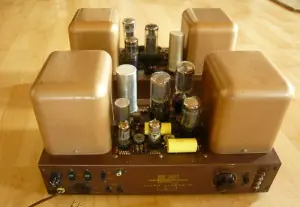
The archive has a pair of Acrosound Ultra-Linear II mono amplifiers, which shows where the idea went next: complete amplifiers built around the company's own transformers.
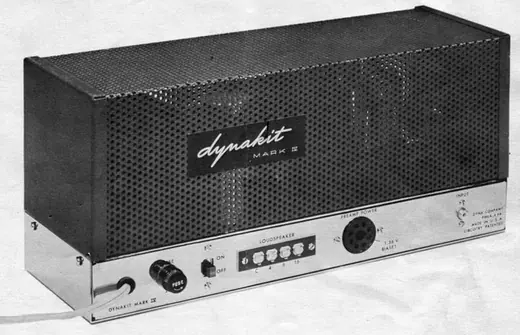
The two partners split in 1954. Hafler met Ed Laurent, and in 1955 they founded the Dyna Company in Philadelphia, later Dynaco. Its first product, the Mark II, was a 50-watt power amplifier sold as a kit or assembled. The Dynaco Stereo 70 of 1959, four EL34 tubes giving 35 watts per channel, used ultra-linear output stages in a simpler three-stage circuit than the Williamson, and it became one of the best-selling tube amplifiers ever built.
How to spot an ultra-linear amplifier
Turn the chassis over and follow the wires from the output tube sockets. On a pentode or beam tetrode, the screen grid is a specific pin (pin 4 on an octal EL34 or 6L6). In an ultra-linear amplifier, that pin runs, usually through a small resistor of 100 to 1,000 ohms, to a lead coming out of the output transformer, not to the power supply. A transformer with five primary leads (two plates, two screen taps, one centre tap) instead of three is a strong clue.
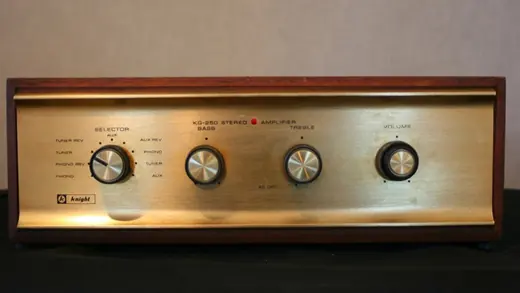
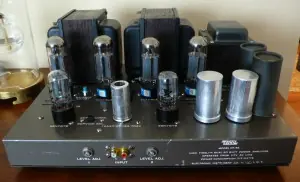
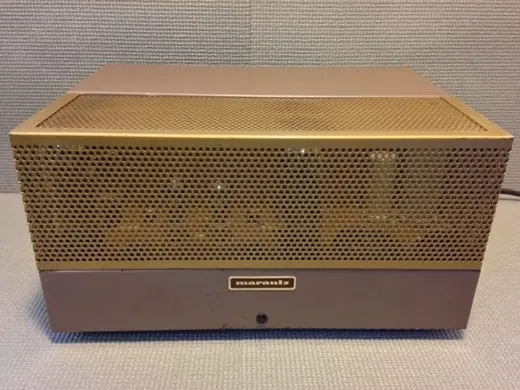
Through the late 1950s and 1960s the connection spread from Dynaco to kit makers and to premium brands such as Marantz. The Knight KG-250 and the EICO HF-89 in this archive come from that period. Check the schematic of the specific model before assuming, though. Manufacturers sometimes printed the word on a transformer that was wired as a plain pentode in a cheaper version.
Is it better than a triode?
On the test bench, a well-designed ultra-linear stage beats a triode-connected one on power and roughly matches it on distortion, while a triode still damps the speaker a little better. In the listening room, opinions split along the same lines as the single-ended versus push-pull argument. Some listeners hear the triode connection as smoother; others hear ultra-linear as fuller and better controlled in the bass.
A few later amplifiers offered a switch between ultra-linear and triode, letting owners decide for themselves. If you own a vintage ultra-linear amplifier and want to experiment, the change is reversible: the screen leads move from the transformer tap to the plate, through the same small resistor. Expect roughly half the power. Do it on one channel first and compare.
The badge after 1960
By the end of the 1950s the term had escaped its definition. Marketing departments printed "Ultra-Linear" on amplifiers whose taps were nowhere near the optimum point, and on some that had no screen taps at all. Wikipedia's article on the subject notes that the term was originally reserved for the optimum tapping condition, which tells you how far usage drifted.
For a collector this has a practical edge. An amplifier with genuine Acrosound, Dynaco or similar ultra-linear transformers is worth more than one with the word stencilled on a can. The transformer part number and a schematic settle the question; the faceplate does not.
Hafler, for his part, left Dynaco in 1974 and founded the Hafler Company in 1977, which built solid-state amplifiers. The tube circuit he named in 1951 outlived that business, and it is still the default output stage in new tube amplifiers made today.
Short answers
Who invented the ultra-linear connection?
Alan Blumlein patented the principle as distributed loading in 1937 (UK Patent No. 496,883). David Hafler and Herbert Keroes named it ultra-linear and published its advantages in Audio Engineering in November 1951.
Where is the screen tap on an ultra-linear transformer?
Partway along each half of the primary winding. A commonly cited optimum is 43% of the primary turns for the KT88; other tubes have their own best positions.
Can I switch an ultra-linear amplifier to triode mode?
On most designs, yes, by moving each screen-grid lead from the transformer tap to the plate of the same tube, usually through the existing small resistor. Expect around half the power. Have a qualified technician do it, because the amplifier holds lethal voltages.
Checked against: Wikipedia: Ultra-linear · Wikipedia: Williamson amplifier · Wikipedia: Dynaco