Hickok 600A Dynamic Mutual Conductance Tube Tester
Archived listing from the original vintage-amplifier.com. Prices, seller details and purchase links have been removed; this page is a reference record, and nothing here is for sale. About this archive.
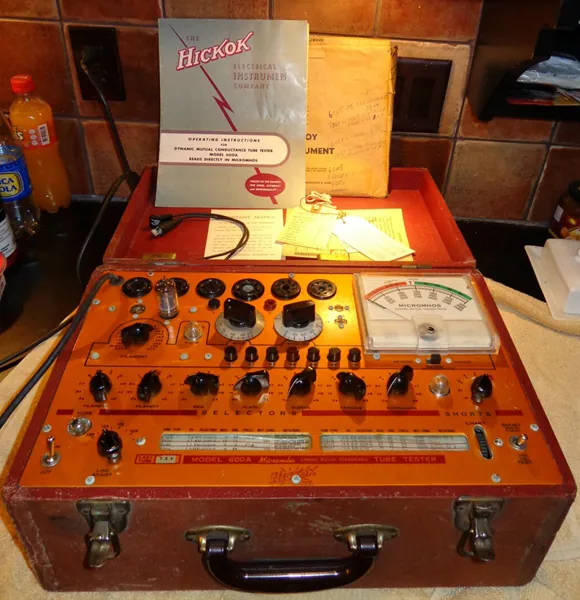
This is a working Hickok 600A Dynamic Mutual Conductance Tube Tester. It is shown testing a 12AU7 tube. It is all original with all factory paperwork and manual. It has a beautiful gold anodized faceplate and the roll chart works nicely. Inside carrying case is nice but the outside of it is scruffy. Don’t be fooled by the calibration people, unless these testers are physically or electrically damaged there are very few points to “calibrate” and they hold their calibration very well and load the tube being tested accurately.
About this model
Hickok's dynamic mutual conductance testers were the instruments American service shops trusted for decades, and the 600A is one of the best known. Radiomuseum dates it to around 1950, with a question mark, and describes a low-profile table model with a triple-scale five-inch meter. This example was all original, with its factory paperwork, manual, gold anodised faceplate and working roll chart, and the seller showed it testing a 12AU7.
The seller's comment that these testers rarely need calibration is one side of a long-running argument among collectors. A tester that has been dropped, stored damp or repaired with the wrong parts can read wrongly without looking damaged, so it is worth checking a 600A against tubes of known condition before trusting it with an expensive matched pair. The tube tester guide explains what a mutual conductance reading measures.
| Maker | Hickok Electrical Instrument Company, USA |
|---|---|
| Model | 600A |
| Type | Dynamic mutual conductance tube tester |
| Date | About 1950 (Radiomuseum, uncertain) |
| Meter | Triple-scale, 5 inch |
| Size | 16.75 × 7.5 × 11.75 in (Radiomuseum) |
Questions collectors ask
What does a dynamic mutual conductance tester measure?
How much a tube's plate current changes for a small change in grid voltage, its transconductance, with working voltages applied. That is closer to how the tube behaves in an amplifier than a simple emission test.
When was the Hickok 600A made?
Radiomuseum dates it to about 1950, marked as uncertain.
Does a Hickok 600A need calibration?
Opinions differ. The archived seller argued they hold calibration well; collectors still recommend checking any old tester against known tubes before relying on it.
Sources: Radiomuseum: Hickok 600A; Wikipedia: Tube tester.