H.H. Scott 220-A Laboratory Power Amplifier
Archived listing from the original vintage-amplifier.com. Prices, seller details and purchase links have been removed; this page is a reference record, and nothing here is for sale. About this archive.
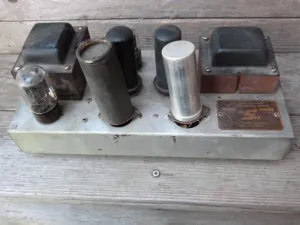
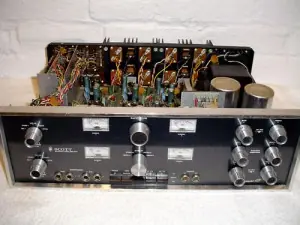
Hermon Hosmer Scott 220-a Laboratory power amplifier amp H.H. Scott vintage 220a. All the information I find on this amplifier says that it is rare. It is not tested it needs to be gone over the caps are loose. overall the chassis looks unmolested but this is a project. Tubes are included. Early 50’s hi fi amplifier.
About this model
The "laboratory" in the 220-A's name echoes Hermon Scott's background: the archive's company history credits him with the RC oscillator, tuned RC circuits and other measurement circuits, and with work on broadcast systems at Bell Telephone Laboratories before he started his own firm. The listing describes an untested early-1950s unit with its tubes, an apparently unmolested chassis and loose capacitors.
A project like this is a good candidate for careful restoration rather than modification. Original early Scott amplifiers are scarce, and the seller's observation that every source calls the model rare matches what collectors report.
An earlier Scott amplifier, the Type 208, survives in the archive only as its nameplate data.
| Maker | H.H. Scott, Massachusetts, USA |
|---|---|
| Model | 220-A Laboratory Power Amplifier |
| Era | Early 1950s (listing) |
| Condition noted | Untested, original chassis, tubes included (listing) |
Questions collectors ask
Why is the H.H. Scott 220-A called a laboratory amplifier?
The name reflects Hermon Scott's background in measurement circuits and broadcast engineering, which the archive's H.H. Scott history page describes.
Should an untested 220-A be switched on?
Not straight from the wall. The capacitors need checking first, and the first power-up should be done slowly with a variac or dim-bulb tester.
Sources: Wikipedia: H. H. Scott, Inc..