RCA
The Radio Corporation of America was the largest American maker of receiving tubes for most of the tube era, and many of the type numbers on amplifiers in this archive started in RCA's laboratories. RCA introduced the 6L6, the first successful beam power tube, in April 1936, and its engineers in Camden, New Jersey, developed the 12AX7, which went on sale in September 1947.
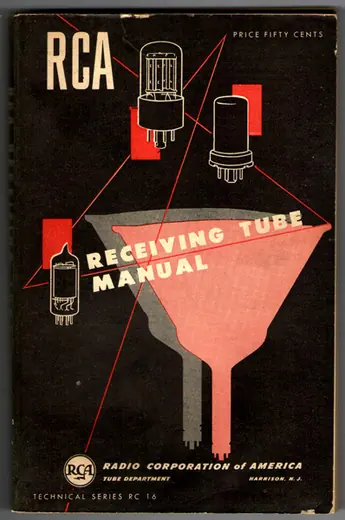
RCA's tube manuals were the standard reference for designers and servicemen, giving characteristic curves, typical operating conditions and basing diagrams for every type it made. Copies are still used at repair benches today.
The archive has a 1950 RCA receiving tube manual, a 1949 RCA 5V4G rectifier, and amplifiers built around RCA tube types such as the 2A3.
RCA: quick answers
Which well-known tube types came from RCA?
Among many others, the 6L6, introduced in April 1936 as the first successful beam power tube, and the 12AX7, developed by RCA engineers in Camden, New Jersey, and on sale from September 1947.
Are old RCA tube manuals still useful?
Yes. They give characteristic curves, typical operating conditions and basing diagrams for each type, which is exactly what you need when checking a substitute or a bias setting.
RCA in the archive
 RCA
RCA 5V4G Rectifier Tube, 1949, in a Sylvania Box
A boxed 1949 rectifier, and why the rectifier type matters.
 RCA
RCA Receiving Tube Manual RC-16, 1950
The reference book of the tube era: theory, testing and data for every RCA receiving type.
 RCA
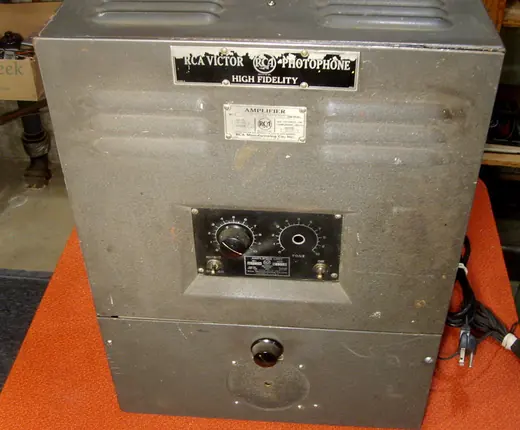
RCA Photophone MI-1223-A Theatre Tube Amplifier
A wall-mounted cinema amplifier from RCA's sound-on-film system.