Magnavox, USA: Early History
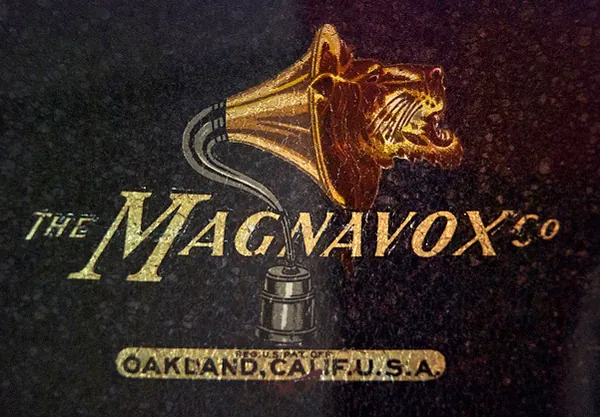
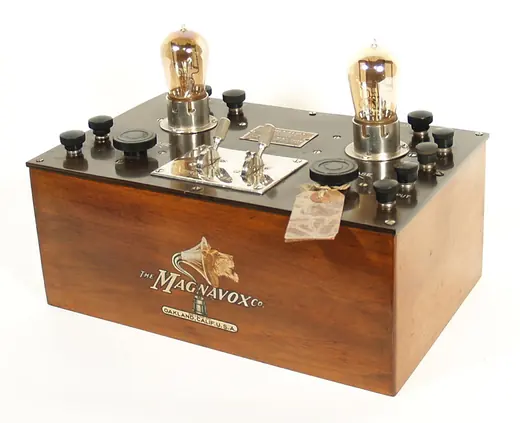
In 1910 Magnavox started as “Commercial Wireless & Development Company” at Napa, California. Peter L. Jansen, Edwin S. Pridham (both ex Federal Telegraph Company) and Richard O’Connor (finance) formed the company to achieve a sensitive telephone receiver. In 1915 Jensen and Pridham have put a horn to their “telephone receiver with moving-coil system” and then used it as a “Fog-Horn” for the local baseball park (Radio & TV News, February 1959). They called it Magna Vox. They developed the “SE4005 noise-cancelling microphone” for aircraft intercoms. In 1919 Magnavox moved from 526 Mission Street, San Francisco to 14th Street in Oakland and made vacuum-tube power amplifiers. In February 1920 Magnavox introduced a radio speaker, forerunner of the 1921 Model R-3. 1924 Magnavox began also to produce a tube “A” with a special design and a year later also radios.
Magnavox: the short history
The original page tells the founders' story from 1910; Wikipedia frames the dates slightly differently. It describes Pridham and Jensen's firm as formed in 1911 and merged with the Sonora Phonograph Distributor Company in July 1917 to create Magnavox, with manufacturing in Fort Wayne, Indiana, by the 1930s. The original page also spells one founder "Jansen"; Wikipedia gives Peter L. Jensen.
Later milestones fall outside the original page: North American Philips took a majority stake in Magnavox in 1974 and full ownership in 1975.
| Company formed | 1917 (predecessor 1910–1911) |
|---|---|
| Founders | Edwin Pridham and Peter L. Jensen |
| Known for | Moving-coil loudspeaker; radio and console equipment |
| Manufacturing | Fort Wayne, Indiana, by the 1930s |
| Acquired by | North American Philips, 1974–1975 |
Questions collectors ask
Who invented the Magnavox loudspeaker?
Edwin Pridham and Peter L. Jensen co-invented the moving-coil loudspeaker at their laboratory in Napa, California.
When did Philips buy Magnavox?
North American Philips acquired a majority stake in 1974 and made it a wholly owned subsidiary in 1975.
Sources: Wikipedia: Magnavox.